Alternatives / SnapShove
Looking for a SnapShove alternative
Prices and features checked How we solve our ranges
The short answer
Move if your losses are on bubbles or against opponents you have a read on. Stay if you want a two-second Nash lookup and know that is what you want.
- SnapShove
- Free · $3.99/mo
- Push Fold Trainer
- Free · $15/mo
Disclosure: Push Fold Trainer is our own product, so treat the comparison accordingly. The prices and capabilities below are the same ones on our trainer roundup, where SnapShove is reviewed alongside everything else - including the reasons to pick it over us.
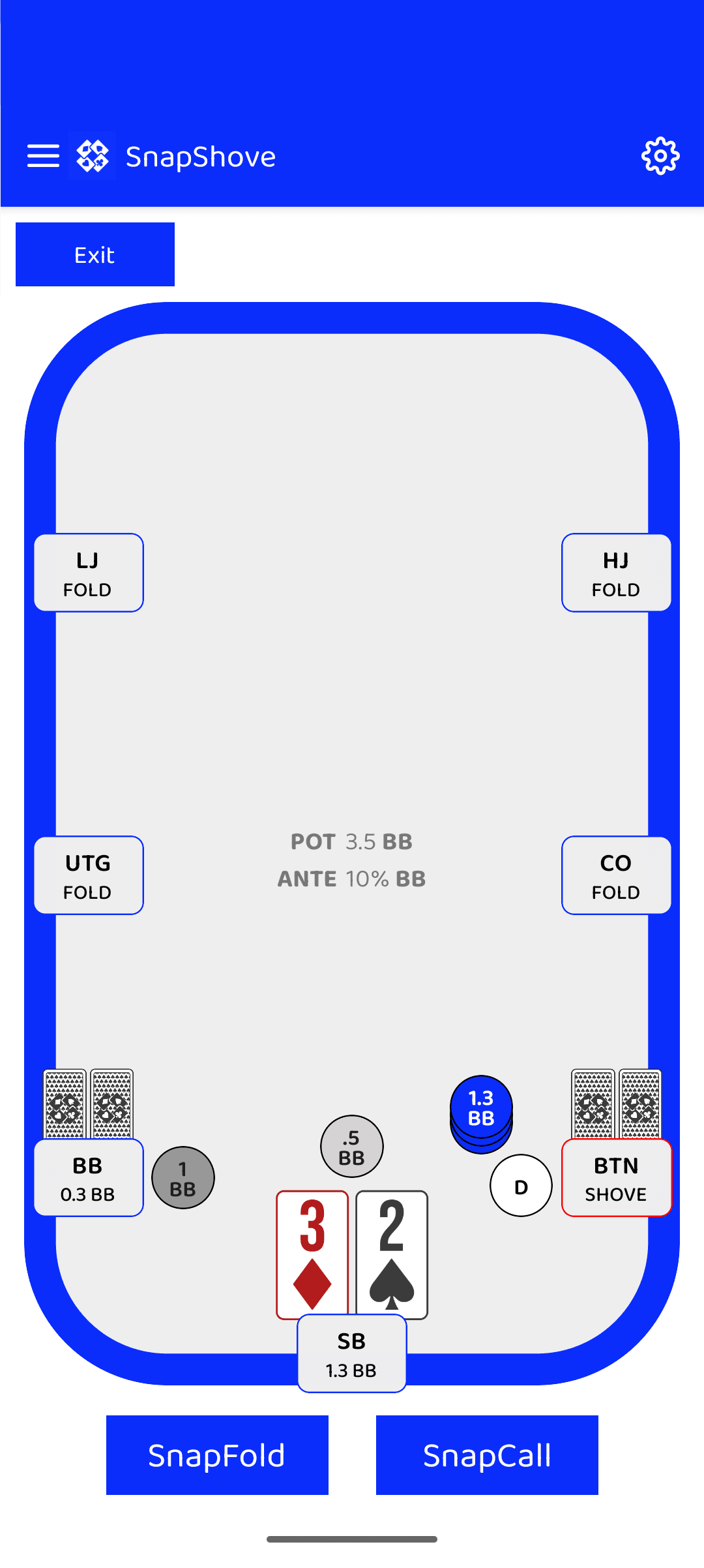
SnapShove is the tool most short-stack players start with, and for the job it was built for it is still hard to beat - a Nash range on your phone in about two seconds, for less than a coffee a month. People go looking for an alternative when the spots they are losing money in stop being the spots it models.
What SnapShove is good at
The original push/fold app, relaunched in 2026 under new ownership with cheaper tiers. Type in a stack, a position and an ante and get a Nash range instantly; every tier includes training simulations. The free tier gives you one calculation a day, which is enough to decide whether the interface suits you before paying anything. Watch what the entry tier covers, though: the cheapest paid plan is shove and call, and reshove training sits on a more expensive one.
- Cheapest paid option here by a wide margin, and the free tier is genuinely usable
- Fastest lookup of anything on this list, and built for a phone
- Training simulations on every tier, including free
- Almost no learning curve - it does one thing
Why players go looking
It has no ICM, and the bubble is where short stacks bleed
SnapShove returns Nash chip-EV ranges. Chip-EV assumes every chip is worth the same, which stops being true the moment a pay jump is in sight - and short stacks spend a large share of their tournament life near one. The hands a chip-EV chart tells you to jam on a money bubble include a band that ICM says to fold, and that gap is not small: on a real bubble the required equity to call can move eight points or more above the pot-odds number. A tool that cannot price that is answering a different question from the one you are actually facing.
It models a GTO opponent, and nobody at your table is one
Nash ranges assume your opponent also plays Nash. The player who folds their big blind 80% of the time and the player who calls off with any ace are both leaving money on the table, and taking it requires a range that is not the balanced one. SnapShove has no opponent modelling in either half of the product, so a read you are confident about has nowhere to go.
The entry tier is narrower than it looks
The cheapest paid plan covers shove and call. Reshove training - the spot where someone has already opened and you are deciding whether to jam over the top - sits on a more expensive one. Worth checking which tier contains the thing you are buying it for before comparing prices.
It answers the hand, but it does not track the leak
A lookup tool answers the spot in front of you and then forgets you were there. The training simulations will score an individual answer, and that is genuinely more than a calculator does - but the analysis is shallow next to the solvers on this list, and there is no running record of which positions and depths you keep getting wrong. That record is what turns a study session into a fixed leak rather than a pleasant half hour.
How the two compare
| Capability | SnapShove | Push Fold Trainer |
|---|---|---|
| Price from | Free · $3.99/mo | Free · $15/mo |
| Drills you | Training sims | Scored, every spot |
| Solved ranges | Nash chip-EV | 4-30bb, 6 & 9-max |
| ICM | Not modelled | Included |
| Exploits | Not supported | Chip-EV + ICM, both |
| Short-stack focus | Only thing it does | Only thing it does |
Where we differ from every tool on that list, SnapShove included, is opponent modelling: the exploit ranges here are solved as best responses across a seven-tier scale of opponent looseness, chip-EV and ICM-aware both, and the practice loop will drill you on them rather than only showing them to you.
What you would give up
The case for moving is above. This is the other half of it - the things SnapShove does that we do not, which are worth knowing before you cancel anything rather than after:
Moving here costs you this
- You will pay more if you go Pro. SnapShove's paid tiers start around $3.99/mo and Pro here is $15/mo. The free tier covers every chip-EV push/fold range without an account, so you can find out whether the difference buys you anything before spending it.
- Nothing here is as fast as SnapShove mid-session. It exists to answer one question on a phone in about two seconds, and a browser-based study tool is not going to beat that between hands.
- Our native mobile app is Android only. The web app runs on any phone, but if an iOS app is specifically what you use SnapShove for, that is a real thing to give up.
When you should stay with SnapShove
Not every reason to look is a reason to move. The cases where SnapShove is still the right answer:
Stay where you are if
- You want a fast lookup on your phone mid-session and nothing more. SnapShove is the fastest tool on this list at exactly that, and paying more for depth you will not open is a bad trade.
- You play mostly chip-EV spots - early levels, deep fields, or cash-game-shaped tournaments where the bubble is a long way off.
- Budget is the binding constraint. Nothing here matches its price, and a cheap tool you actually use beats an expensive one you do not.
If you do move
A page that argues someone into switching and then leaves them at the decision has done the easy half. Three steps that make the move cheap to test and cheap to reverse:
Keep SnapShove for the table, if that is where you use it
These are not really the same purchase. A two-second lookup between hands and a study session that drills you until the answer is automatic are different jobs, and at SnapShove's price running both is a much smaller decision than switching.
Start on the free ranges rather than a subscription
Every chip-EV push/fold range here - 4bb to 30bb, 6-max and 9-max, open-raise and facing an open - is free and unlimited with no account. That is the same class of answer SnapShove's paid tier returns, so compare the two directly before paying anyone anything.
Then drill the spots you actually play
Pick the positions and depths that make up most of your sessions and work through them in the practice loop. Accuracy is tracked per position and per depth, so after a few sessions it tells you where the money is going instead of leaving you to guess.
SnapShove alternatives: common questions
- Is there a free SnapShove alternative?
- Yes. Every chip-EV push/fold range here is free and unlimited with no account - 6-max and 9-max, open-raise and facing an open, 4bb to 30bb - along with the ICM, bubble factor and satellite calculators. SnapShove's free tier gives you one calculation a day. What is paid here is the ICM and exploit practice, not the charts.
- Does SnapShove model ICM?
- No. SnapShove returns Nash chip-EV ranges, which price every chip the same. That assumption stops holding the moment a pay jump is in sight, and short stacks spend a lot of their tournament life near one. If bubble spots are the thing you are trying to fix, this is the gap that matters.
- Does SnapShove train you, or only answer you?
- It does both, and this is often reported wrongly. Training simulations are included on every tier, the free one included. The limit is what it trains you on: Nash chip-EV spots against an opponent who is also playing Nash, with no ICM and no opponent adjustment anywhere in the product.
- What is the cheapest SnapShove alternative that includes ICM?
- Among the tools on our roundup, ICMIZER starts at about $15/mo and Pro here is $15/mo with ICM included - though ICMIZER's drilling half sits on its PRO tier. GTO Wizard puts ICM around $79/mo and DTO around $29.99/mo. Prices were last checked on the date shown at the top of this page.
- Can I use SnapShove and this together?
- Yes, and for a lot of players that beats switching. SnapShove is the fastest lookup on the list and costs very little; this is a study tool that drills you and tracks what you miss. There is nothing wasteful about running both.
The free tier covers every chip-EV push/fold range, 4bb to 30bb, 6-max and 9-max, plus the ICM, bubble factor and satellite calculators. No account needed to look at any of it.